*Available for PRE-ORDER*
U.S. | UK
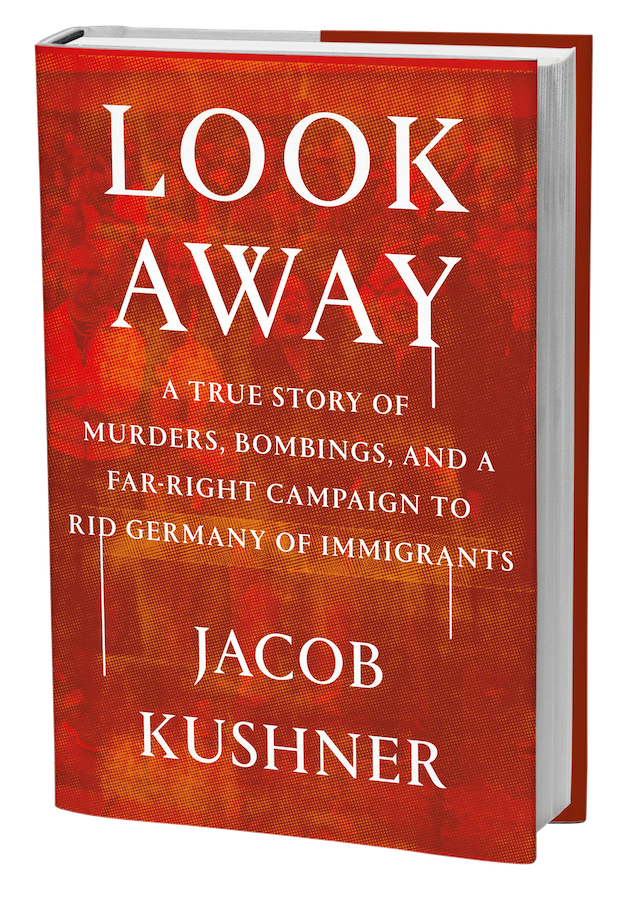
LOOK AWAY: A True Story of Murders, Bombings, and a Far-Right Campaign to Rid Germany of Immigrants (U.S.)
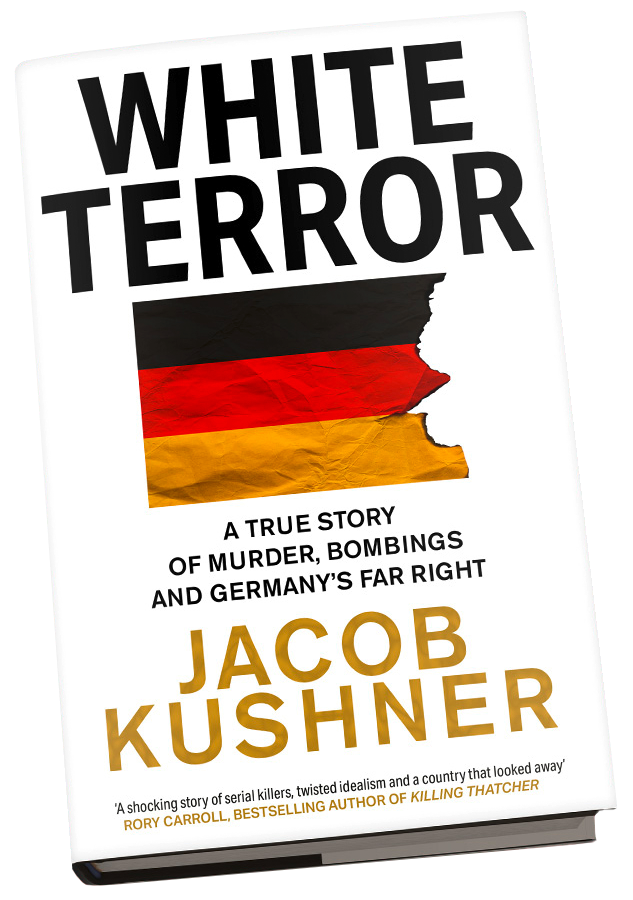
WHITE TERROR: A True Story of Murder, Bombings and Germany’s Far Right (UK)
By Jacob Kushner
Coming May 2024 by Grand Central (Hachette); Harper Collins UK
Not long after the Berlin Wall fell, three teenagers became friends in the East German town of Jena. It was a time of excitement, but also of economic crisis: some four million East Germans found themselves out of jobs. The friends began attending far-right rallies with people who called themselves National Socialists: Nazis. Like the Hitler-led Nazis before them, they blamed minorities for their ills. From 2000 to 2011, they embarked on the most horrific string of white nationalist killings since the Holocaust. Their target: immigrants.
Look Away/White Terror follows Beate Zschäpe and her two accomplices—and sometimes lovers—as they radicalized within Germany’s far-right scene, escaped into hiding, and carried out their terrorist spree. Unable to believe that the brutal killings and bombings were being carried out by white Germans, police blamed—and sometimes framed—the immigrants instead. Readers meet Gamze Kubaşık, whose family emigrated from Turkey to seek safety, only to find themselves in the terrorists’ sights. It also tracks Katharina König, an Antifa punk who would help expose the NSU and their accomplices to the world. A masterwork of reporting and storytelling, Look Away reveals how a group of young Germans carried out a shocking spree of white supremacist violence, and how a nation and its government ignored them until it was too late.
Praise for White Terror / Look Away
“Jacob Kushner’s Look Away is, at one level, a compelling true-crime thriller about a trio of German terrorists on the run. But it’s also a warning about the dangers of white supremacy and right-wing extremism – and about how the fear and hatred of immigrants, combined with the incompetence (or worse) of law enforcement, remains a threat around the world.” — Jeffrey Toobin, New York Times bestselling author of Homegrown: Timothy McVeigh and the Rise of Right-Wing Extremism
“Exceedingly well-written and deeply reported—a fascinating and disturbing book.” —Peter Bergen, author of The Rise and Fall of Osama Bin Laden
“With a novelist’s skills for drama and scene, Kushner shows the dangers of complacency in the face of gathering violence. Such terrible truths, so deftly told, remind us why we should not—and cannot afford to—look away.” —Kim Cross, NYT bestselling author of In Light of All Darkness and What Stands in a Storm
“A searing and infuriating read about a nation still grappling with the ghosts of its past.” —Joshua Hammer, author of The Falcon Thief
“Jacob Kushner’s Look Away is a damning account of a problem seen in the U.S. and around the world: how law enforcement’s obsession with informants can blind them to real threats of domestic terror.” —Trevor Aaronson, author of The Terror Factory
“Jacob Kushner is a masterful storyteller who never loses sight of the humanity of his story’s immigrant victims and their families. An important and urgent book.” —Julia Lee, author of Biting the Hand
“Discomfiting as it is meticulously researched, Look Away is not just a terrifying window into revived German extremism but a warning to the world—a reminder that, at the end of the day, violent racial authoritarianism knows no borders.” —Jonathan M. Katz, author of Gangsters of Capitalism
“This expertly reported story of three friends who committed unspeakable hate crimes is a cautionary tale about ignoring the lessons of history and realities of the present.” —Seyward Darby, author of Sisters in Hate
“This fascinating book tells two stories: first, how a gang of East German thugs turned neo-Nazi ‘bomb tinkerers’ grew into a network of domestic terrorists, and second, how German authorities let them get away with murder. Jacob Kushner tells the story with cautious condemnation and intimate detail.” —Michael Scott Moore, author of The Desert and the Sea
“Kushner’s natural, commanding voice recalls the classic nonfiction writers John Hersey and William Langewiesche, and the depth of his reporting is only exceeded by the streamlined, engrossing way he tells his story–a story about the questions that lie at the heart of politics in so many societies: what is “terror” and who are its real victims?” —Eve Fairbanks, author of The Inheritors
“Jacob Kushner’s Look Away has the pacing and taut prose of a crime thriller while also managing to be a smart and thorough analysis of right-wing extremism in Germany.” —Alexander Stille, author of The Sullivanians
“Timely, chilling, and unforgettable, Look Away is an urgent warning that willful blindness about the present is as pernicious as failure to reckon with the past. A must-read for anyone concerned about the rise of far-right extremism.” —Becky Cooper, bestselling author of We Keep the Dead Close
“Jacob Kushner’s White Terror is a shocking story of serial killers, twisted idealism and a country that looked away. With impeccable research and a spellbinding narrative Kushner takes us into a dark heart of extremism and the moral murk of what passes for liberal democracy. For anyone who cares about shared humanity and the rule of law, this is a wake-up call.” —Rory Carroll, author of There Will Be Fire / Killing Thatcher
“This staggering account from journalist Kushner connects the dots between Germany’s far-right movement and a string of terror attacks from 2001 to 2010…Readers will be shocked and dismayed.”—Publishers Weekly (starred review)
“A perceptive and engrossing examination of a horrifying chapter in Germany’s recent history.” —Kirkus Reviews (starred review)
About the author:

Jacob Kushner is a foreign correspondent who writes magazine and other longform articles from Africa, Germany, and the Caribbean. His writing has appeared in dozens of publications including the New York Times, The Atlantic, Harper’s, The New Yorker, VQR, The Economist, National Geographic, The Atavist, Foreign Policy and The Guardian. He is the author of China’s Congo Plan, which was favorably reviewed in the New York Review of Books. A Fulbright-Germany scholar and Logan Nonfiction Fellow, he was a finalist for the Livingston Award in International Reporting. He teaches and advises ambitious young journalists at the Pulitzer Center, the Overseas Press Club, and several universities.
For publicity, speaking, or media inquiries: Roxanne Jones (Hachette USA) | Hetty Touquete (Harper Collins UK)
Literary and film representation: Elias Altman (Massie & McQuilkin)