Hopes for African tech are high. But who will train the coders?

OZY.com


A good coder is hard to find, as Kenyan entrepreneur Tonee Ndungu knows. Nairobi is chock-full of mediocre ones, while those with real skills are in such high demand they work “five jobs at the same time,” says Ndungu, whose startup, Kytabu, aims to bring digital textbooks to African schoolkids. Ndungu searched far and wide, from Kazakhstan to India, and nearly sputtered for lack of talent.

Then he learned of Moringa School, a for-profit startup that aims to turn tech-savvy Kenyans into employable programmers and developers, coders and designers in a matter of months. After visiting Moringa’s classrooms this spring, Ngundu offered two students 14-day internships — and hired them almost immediately afterward. The pair are working so quickly, Ngundu says, that he has moved up Kytabu’s launch date by three months.

As cities like Nairobi, Lagos and Kigali become major tech investment hubs, the promise of smart new jobs has rightly generated a lot of hope. Picture far-away armies of bright young developers, coders and UX specialists quietly building the infrastructure of the global digital economy while boosting their own prospects. It’s a fine picture, indeed. But an important question remains, and it has become a quandary for entrepreneurs, aspiring techies and governments alike: Who will train the young Africans to fill the jobs?

Find out at OZY.
In Pursuit of Africa’s Missing Trillion

Columbia Graduate School of Journalism - Covering Business

In recent decades, Western media has tended to place the blame for Africa’s problems overwhelmingly on African shoulders. Given portrayals in the mainstream press, for example, one could have been forgiven for thinking that Robert Mugabe’s ongoing state plunder in Zimbabwe or the Joseph Kabila administration’s secret mining deals in Congo were purely African scandals, manufactured by Africans without any outside help.

And yet a subtle shift in western media’s coverage of Africa is underway: today many news outlets are making great efforts to uncover the ways in which foreign corporations and actors from North America, Europe and Asia are central to corruption on the continent.

Read the full story at the Columbia University Covering Business blog.

Birthright Denied

Moment Magazine

Story and photos by Jacob Kushner

The campaign to expel the children of Haitian immigrants in the Dominican Republic is impractical. Their labor—and that of their parents—helped propel the Dominican economy last year to grow faster than all but one other country’s in Latin America, firmly establishing it as a middle-class nation. They are a significant part of the workforce in the booming construction and tourism industries that have helped transform the Dominican Republic into the most popular travel destination in the Caribbean.


But in a chaotic democracy that has adopted 38 different constitutions over a century and a half, anti-Haitianismo is the one enduring notion that mainstream parties across the political spectrum can invoke with impunity. It is driven by the fervor of Dominican nationalists, and, in particular, by one powerful, ultra-conservative family and its allies. Together, they are waging a political, legal and media war to defend the Dominican Republic against what they believe is the nation’s gravest threat: Haitian immigrants and their children.

Read: Moment Magazine 

Is This Africa’s Real Silicon Savannah?

OZY.com

Jacob Kushner for OZY

Off a dirt road, atop a grassy hill, the plains of central Kenya seem endless. The nearest town is a decent hike away. But here, in the middle of nowhere, I pull out my iPhone, and within seconds I’m checking my email on a hot spot provided by Mawingu Networks. The connection is superb.

Is this Africa’s real Silicon Savannah? Even as Kenya, South Africa and Nigeria vie for that mantle and the jobs that come with it, they’ve focused mostly on cities, neglecting the farmland and actual savannahs that lie beyond. Conventional wisdom says the countryside’s lack of infrastructure makes broadband too daunting; titans like Google and Facebook are looking to balloons and drones to solve the rural Internet conundrum. Which is why Mawingu Networks’ solution is so remarkable. Not only does it bring the Internet age to the boonies, and cheaply, but it does so with a technology so old you might not know about it: TV white space.

Read the full story at OZY.

Haiti’s half-billion dollar question

VICE Magazine

Photo by Santiagockn / 2010

The Red Cross has adopted a better approach to help Haitians recover from the 2010 earthquake—but past mistakes might plague its future.

When an earthquake decimated Haiti’s capital and nearby cities in 2010, people around the world pledged $13 billion in aid, $488 million of which was donated to the American Red Cross — the largest branch of the world’s largest relief charity.

In June, an NPR/ProPublica report alleged that the Red Cross had misused and wasted funds it devoted to housing, building only six out of 700 planned homes and failing to shelter anywhere near as many displaced Haitians as it had claimed.

But if the agency misappropriated its resources, it did so largely at the direction of Haiti’s leaders.

Five years after the earthquake, some 64,000 Haitians remain officially displaced, and tens of thousands more reside in temporary shelters or on land from which they face eviction. Roughly 150,000 of them live in a desolate stretch of land at the foot of the mountains north of Port-au-Prince that Haitians call Canaan — the biblical Promised Land.

The Red Cross’s forthcoming work in Canaan illustrates its evolving understanding of the infrastructural challenges that disaster recovery entails. But critics of its effort in Haiti insist that this does not absolve it of what they say were harmful mistakes. Read: VICE

When Kenya kills: A family’s quest for justice

GlobalPost/GroundTruth

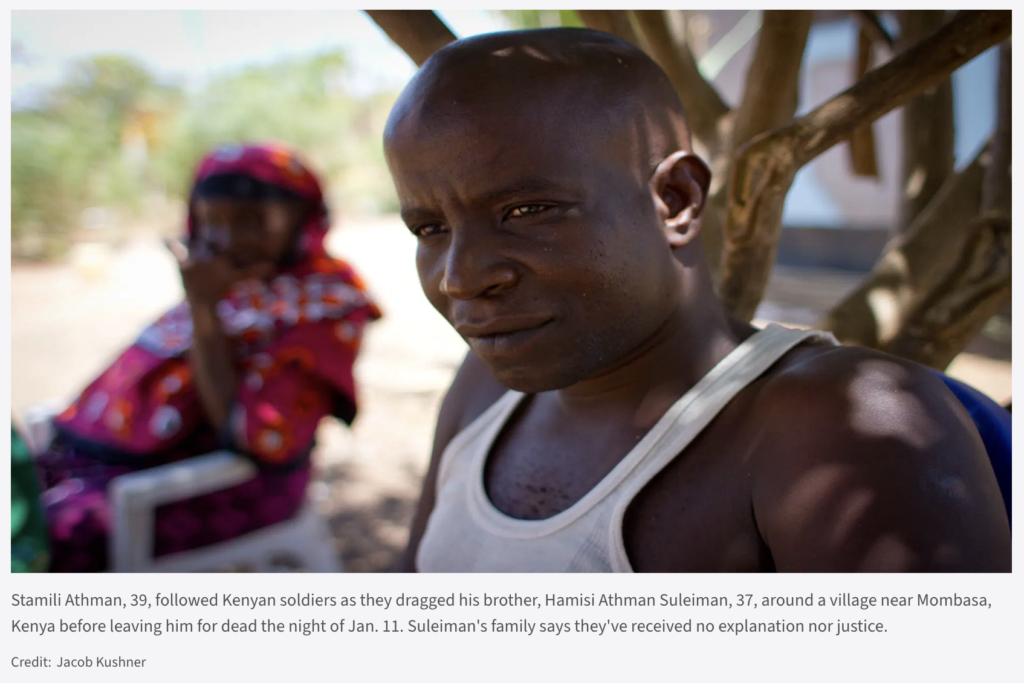
Hamisi Athman Suleiman was a hardworking man. Born to a large Muslim family in the rural area of Mtongwe, just south of Mombasa on Kenya’s coast, Suleiman was a daily laborer doing odd jobs in the apartments of the military officers who lived at a naval base a short walk from his home.

On Jan. 11, sometime between 6:30 and 9:30 p.m., some of those military officers allegedly murdered Suleiman, 37, leaving his body in the woods.

According to eyewitnesses, interviews with local justice officials and documents from an array of civil rights and government accountability groups — as well as a full review of Suleiman’s court case — indicate he is one of hundreds of Kenyans and refugees who have been killed by Kenyan police and other law enforcement officers in recent years.

Read the full GroundTruth investigation at PRI’s The World.

Kenya’s anti-terror police are inflicting terror of their own

GlobalPost/GroundTruth

NAIROBI, Kenya — Kenyan police have fueled the fires of Islamic extremism and may actually be undermining the country’s security in an overzealous attempt to protect it, according to human rights activists and advocates for police reform.
Widespread allegations of police corruption, brutality and arbitrary arrests that target Kenya’s Muslim minority population appeared to inform President Obama’s comments in a joint press conference with Kenyan President Uhuru Kenyatta on Saturday, part of Obama’s first trip to his father’s homeland since becoming president of the United States.

“What we have found through hard experience — I have shared this with President Kenyatta — is that if you paint any particular community with too broad a brush, if in reaction to terrorism you are restricting legitimate organizations, reducing the scope of peaceful organization, then there can have the inadvertent effect of actually increasing the pool of recruits for terrorism and resentment in communities that feel marginalized,” Obama said.

Read the full GroundTruth story at PRI’s The World.

Did Obama Avoid the Difficult Questions in Kenya?

OZY.com

Till Muellenmeister/Getty

In an age of terrorism, many countries — the United States among them — face a difficult balance between security and civil rights. For Kenyan President Uhuru Kenyatta, the fight against al-Shabab is no less than “existential.” But human rights groups here say the way Kenya is fighting terrorists will only cause instability and insecurity in the long run. When Muslims see their peers extorted, or worse, by the police, the natural response is anger. A few may even be drawn into the arms of the terrorists, says Mgandi Kalinga, an investigator with local human rights group Haki Africa. A few is all it takes. And so, “the security situation in Kenya is compromised by the government itself,” Kalinga said.

More than any other U.S. president in history, Barack Obama has the chance to shape the course of Kenya’s fight against al-Shabab, not just because of his Kenyan ancestry, but because the United States has helped fund it and train those who are carrying it out. His visit to Kenya over the weekend offered an unprecedented opportunity to influence its parameters.

Did Obama dodge the difficult questions?

Read the full story at OZY.

Can Obama Push Kenya to Take Action on Terrorism and Human Rights?

TakePart

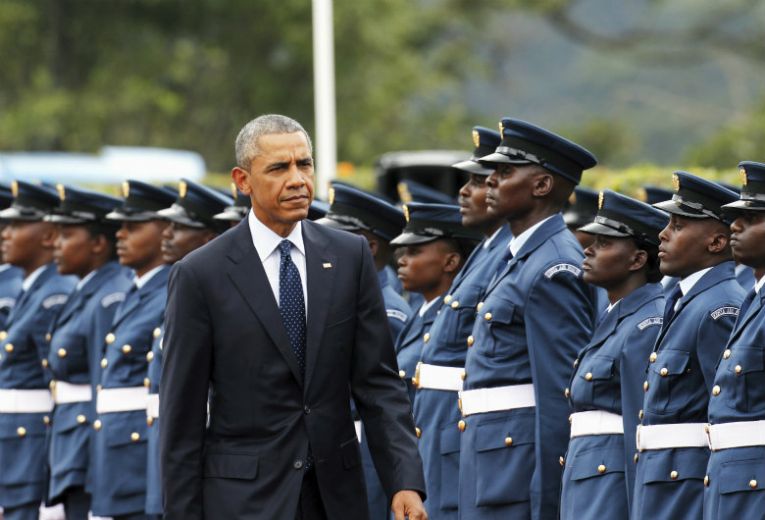
President Barack Obama reviews a Kenyan Defense Force honor guard in Nairobi. (Photo: Thomas Mukoya/Reuters)

NAIROBI–Barack Obama is visiting his father’s homeland for the first time as president, and he could hardly have chosen a more critical moment. Kenya was once a peaceful nation known for safaris and beaches. But it has, sadly, evolved into something resembling a police state—the result of the Kenyan government’s response to a recent onslaught of terrorist attacks.

As Kenyan security forces attempt to defend their nation, terrorism analysts and human rights activists say they’re going about it all wrong—inflicting collective punishment on Muslims and clamping down on press. Now, one very big question remains: Can President Obama convince Kenya’s leaders to take action on terrorism and human rights?

Read the full story at TakePart.

Obama Heads to a Kenya in Turmoil on His First Visit to the Country as President

VICE Magazine

VICE News.

Millions of Kenyans are celebrating the long-awaited return of Barack Obama, who on Friday will visit his father’s homeland for the first time as president to attend the 2015 Global Entrepreneurship Summit in Nairobi.

Obama’s visit will focus on economic development and counterterrorism efforts within the country against the Somali Islamist group al Shabaab, but it comes amid widespread abuse by Kenyan security forces of Muslims, refugees, and journalists. This has raised worries among rights advocates that he risks lending undue legitimacy to one of Africa’s more unscrupulous regimes.

Obama is visiting a country whose human rights record has taken a notably downward turn. Following years of steady attacks from al Shabaab militants within Kenya, including an assault on Nairobi’s Westgate shopping mall in 2013 that killed 67 and the massacre of 147 people at a university in Garissa earlier this year, local security forces are said to consistently engage in extrajudicial activity in the name of fighting terrorism, and are accused of harassing journalists and undermining press freedoms.

Read: VICE

In Africa, being gay makes you a target for extortion

GlobalPost/GroundTruth

Eric Gitari, the head of the National Gay and Lesbian Human Rights Commission of Kenya, one of the main (and only) Kenyan LGBT advocacy groups, poses for a portrait in the NGLHRC offices. Jake Naughton/The GroundTruth Project

By Anthony Langat & Jacob Kushner

NAIROBI, Kenya — LGBT advocates in Kenya say blackmail and extortion of gay people is on the rise, enabled by the fact that homosexuality is both unaccepted and illegal here.

Read the full article at GroundTruth.

Guns, knives and rape: The plight of a gay Ethiopian refugee in Kenya

GlobalPost/GroundTruth

Jake NaughtonGroundTruth Project

Chased away from his home country by gun-wielding homophobic men only to be raped in Kenya and abused by police there, Ibrahim, a 33-year-old gay refugee from Ethiopia, tells his story.

Read the full article and see photos by Jake Naughton at GroundTruth.

Inside the nightmares of Africa’s LGBT refugees

GlobalPost/GroundTruth

Raj, a gay Ugandan who arrived in Kenya on his 20th birthday, sits in a park in downtown Nairobi. Jake Naughton/The GroundTruth Project

NAIROBI, Kenya — Cynthia, an LGBT activist in Burundi, was thrown in jail and beaten up by police after she gave a radio interview defending the rights of gays and lesbians. Upon her release she fled to Kenya.

Raj, a gay teenager from Kampala, Uganda, was found kissing a boy in his high school locker room and the principal called an all-school assembly to shame him. The principal then ordered teachers to beat him. Afterward Raj’s father drove him to jail and asked police there to further punish him. After several days of beatings, the police released Raj, and he too fled to Kenya.

Mbonimpa, a gay man who fled Congo’s civil wars for Kenya as a boy, was reported to police at Kakuma refugee camp by his own mother. Ineligible for asylum, he’s living in Nairobi where he hopes no one will learn of his sexual identity.

Gay Ugandans fleeing a wave of homophobia have been covered widely in the international media. But LGBT people are fleeing countries across East and Central Africa, where religious crusaders are pushing forward anti-gay laws.

Over the course of four months, GroundTruth interviewed and stayed in touch with LGBT refugees from Uganda, Rwanda, Burundi, Congo and Ethiopia — all countries where anti-gay ideology is on the rise.

Read the full story at GroundTruth or the Huffington Post. 

Going where few Western reporters dare, Sudanese journalists document the relentless fight in Sudan’s Nuba Mountains

Vocativ

Nuba Reports

In rural Africa, time is measured in seasons—planting season and harvest season, rainy season and dry. In South Kordofan, there is another: bombing season. It’s the period roughly between December and July when Khartoum sends troops, rockets and warplanes to attack civilians in their homes, markets and schools.

Read the full story at Vocativ.

Anti-LGBT groups are making inroads across East Africa

GlobalPost/GroundTruth

Simon MainaAFP/Getty Images

Jacob Kushner and Anthony Langat

NAIROBI, Kenya — Two years after Ugandan legislators proposed a law that would condemn active homosexuals to death, a precedent is spreading throughout the region.

In Kenya, one political party is now working to do the same after drafting a lengthy anti-homosexuality bill that it hopes Kenyan lawmakers will soon enact.

“For our local citizens it proposed life sentences. For the foreigners we propose stoning to death,” said Vincent Kidaha, President of Kenya’s Republican Liberty Party. “There is no African, no Kenyan who is born homosexual. It’s not natural.”

Read the full story at GroundTruth. This article was also featured by NBC News.